


Iran Yet to Play Shia Card
By Rohit Srivastava
On March 20, NATO Mission in Iraq relocated all its personnels and Command to Naples, Italy. With this the NATO forces left Iraq after 23 years. NATO member forces were part of the US led campaign against Iraq launched in March 2003. “I would like to thank the Republic of Iraq and all the Allies who assisted in the safe relocation of NATO personnel from Iraq. I would also like to thank the dedicated men and women of NATO Mission Iraq, who continued their mission throughout this period. They are true professionals,” said General Alexus Grynkewich, Supreme Allied Commander Europe.
The aggressive posturing of pro-Iranian militia and armed Shia groups in Iraq against US bases across their country is the prime reason why NATO decided to move out. This is one major victory of Iran in the ongoing war. On January 17, US forces were withdrawn from Ain al-Asad Airbase, in Western Iraq. At present US military is present at Victoria Base Baghdad, near Baghdad International Airport, Erbil in Northern Iraq and Harir Air Base in Kurdistan region. US and Iraq, in 2024, had agreed on complete withdrawal of US forces from Iraq by September this year. The pressure from Shia militia of Iraq and pro-Iran groups compelled two sides to agree.
US military bases are under constant attack from pro-Iran Popular Mobilization Forces (PMF), part of Iraq army with drones and mortar. In US led occupation of Iraq from 2003 onwards, Iran backed Shia militia gave serious challenge. The insurgency that lasted for almost a decade ensured that US and allied forces which were simultaneously present in Afghanistan and Iraq would not dare launch land invasion of Iran. The Shia militias with Iran’s backing kept the allied forces engaged in Iraq, thus ensuring security of Iran. A perfect case of forward defence. With buzz on US sending its ground troops to invade Iran, it is important to revisit the geopolitical power that Shia population holds in the region.
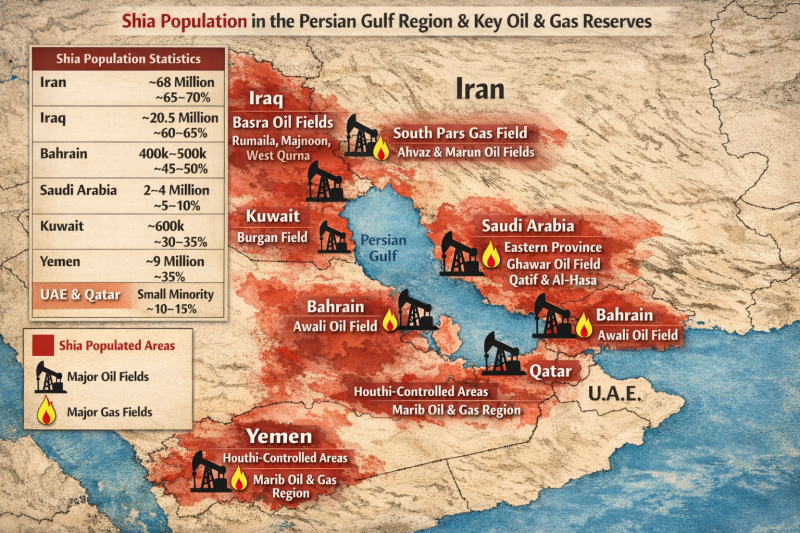
Shia Muslims form a significant demographic in the Persian Gulf region, with Iraq and Iran being majority-Shia states, while Bahrain and parts of Saudi Arabia’s Eastern Province also have large concentrations. In contrast, Kuwait, Qatar, Oman, and the UAE host smaller but notable Shia minorities.
Iran (89%) and Iraq (50+%) dominate Shia demographics in the region. Shias in Iran are concentrated in the southern half of the country which borders Kuwait (25%), Iran and Gulf. Bahrain, at present, has almost equal Shia and Sunni population. Yemen has near parity between Sunni and Shia, often leading to political tensions. Saudi Arabia’s Shia are concentrated in oil-rich Eastern Province on western bank of Persian Gulf making their presence strategically significant. Oman, Qatar, and the UAE host smaller Shia populations, often integrated but politically sensitive. Bahrain was a Shia majority nation ruled by Sunni King. Bahrain’s Shia majority is often seen through the lens of Iranian influence, though local Shia identity is distinct and rooted in Bahraini history.
The geopolitical implication of a weaponized Shia population in the Gulf region could be extremely destabilizing in favour of Iran who leverages Shia populations across the Gulf to project influence. Bahrain and Saudi Arabia face periodic unrest linked to Shia grievances over political representation. Case in point is Houthi Shia of Yemen who have reshaped regional power balance and have emerged as a major military power dominating red sea and horn of Africa.
The Sunni population in Bahrain (historically Shia majority) increased primarily through deliberate state-led policies of political naturalization and selective citizenship grants to Sunni migrants, alongside demographic engineering efforts by the ruling Al Khalifa dynasty.
The increase in Sunni population in Bahrain achieved through citizenship grants to Sunni migrants, recruitment into security forces, and manipulation of census data. This demographic engineering is central to Bahrain’s sectarian politics and its reliance on Saudi/GCC support.
Shia Region and Oil Fields
Shia-populated regions in the Persian Gulf overlap heavily with oil and gas reserves of Iran, Iraq, Bahrain, and Saudi Arabia. This geographic coincidence makes Shia communities strategically significant in global energy politics. Ironically, except Iran, Shias are not the ruling class of the oil field owning countries. In spite of majority Shia and oil being in Shia region of Iraq, the political and economic power was always under the control of Sunni elites.
In Saudi Arabia, despite being a minority, Shia’s dominating presence in the oil-rich eastern region is geopolitically sensitive. Riyadh tightly controls this area due to its economic importance. Sunnis tightly control the wealth and Shia are treated as second class citizen. This also makes the country economic security vulnerable and there is a faultline available for exploitation.
This intersection of Shia demographics and hydrocarbon reserves is least explored part of Persian Gulf geopolitics. Control over these reserves gives Shia populations disproportionate strategic weight in global energy security and Iran is well placed to exploit it.
Iran’s Shia Card
The success and survival of Sunni petrodollar emirates and House of Saud is based on their control over gulf oil. All of them are Sunni and are aligned with US and Israel. They host US bases being used against Iran. Both sides of Persian Gulf are populated by Shia and they are not being treated well by their respective Sunni royalties, if Iran is able to mobilize Shia populations against rulers of Gulf states, there can be a revisit of Arab Spring of 2011.
Iran was able to organize resistance force in Iraq against US, it can repeat again. This is the trump card that Iran can use to push the whole region into civil war and governments may topple like pack of cards. This is the reason why Saudi Arabia is pushing for sustaining US attack on Iran where as Gulf emirates wants peace. They are too tiny and exposed to face prolonged hostilities. Saudi has strategic depth in red sea region to survive Iranian onslaught.
Shia militia is the weapon which is still under cover. Iran may unsheathe it when land invasion is imminent.

