

India must Decide on Su-57
By Rohit Srivastava
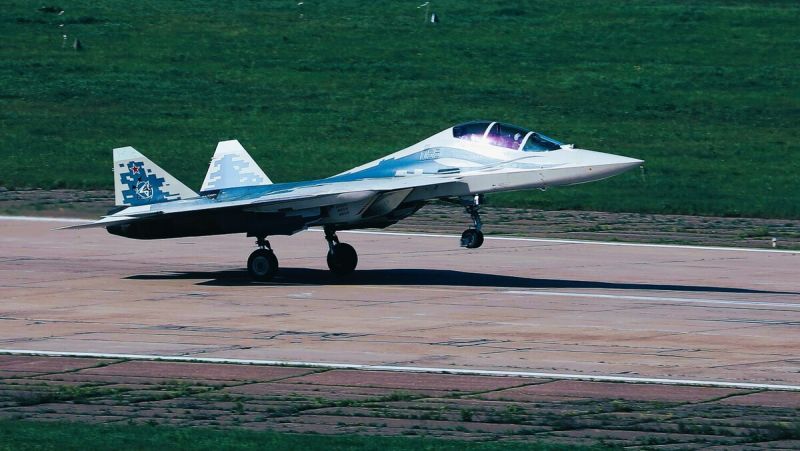
Recently, Rostec announced that the twin-seat version of the Su-57 is undergoing flight trials. This represents the latest development for the Su-57, which is being rapidly modernized and improved based on Russian experience in the ongoing conflict with Ukraine. According to Rostec—the parent company of the United Aircraft Corporation (UAC), the jet's developer—the two-seat fighter first took to the air in May of this year.
The company further stated that the Su-57D will solve pilot training challenges by moving beyond ground-based simulators. The twin-seater is also being developed to integrate upcoming sixth-generation technologies, including the airborne control of unmanned aerial systems (UAS).
"This is important for controlling highly intelligent systems like the Okhotnik, as well as swarm and group systems, when the primary pilot and crew are focused on completing the main combat mission," said Mikhail Strelets, director of the Sukhoi Design Bureau (part of the UAC), during the Military Acceptance program.
In addition, the two-seat modification will be used to test combat artificial intelligence (AI), which UAC specialists are currently developing.
The Indian Fighter Dilemma
To fulfill the Indian Air Force (IAF) fighter requirement, India sent a long-awaited formal request to France for 114 additional Rafale fighters. The Letter of Request (LoR) was sent earlier this year in May. Reportedly, 90 of these aircraft would be manufactured locally through a domestic partner.
However, as analyzed by IDI in February, the relevance of 4++ generation fighters is diminishing in modern warfare. Even under the best possible timeline, the Rafale may not be the optimal choice for the future against potential adversaries—especially with China already flying prototypes of two of its 6th-generation fighters, the J-36 and J-50. At present, India remains one generation behind the global standard, with no 5th-generation fighters in its fleet.
The Engine Enigma
India's 4th and 5th-generation fighter programs face hurdles because India selected the US-made GE F404/F414 engines to power its home-grown aircraft. This choice has given the US significant leverage over a future competitor. Historically, the US has pressured countries like Canada and Israel out of pursuing independent fighter programs, and it rarely allows its allies to maintain completely independent combat aircraft projects. More recently, France was sidelined from the Australian submarine program. Consequently, India's delayed fighter programs risk becoming obsolete before completion.
In response, Russia offered its latest engines with a complete Transfer of Technology (ToT) during the last Aero India exhibition. Its 177S engine can directly replace the AL-31FP engines currently powering India's Su-30MKI fleet.
Why the Su-57D Matters
One of the IAF's primary demands during the early years of the program (around 2010) was a twin-seat version. This requirement is finally being fulfilled by the Su-57D variant that made its maiden flight on May 19. India traditionally prefers to train its pilots on twin-seat jets before clearing them for solo missions.
The Su-57 is a rapidly evolving platform and stands as one of the most battle-tested fighter jets today. The weapons complement for its export variant, the Su-57E, is being continuously upgraded. It features:
RVV-SDM air-to-air missiles with a range of up to 190 km.
RVV-BD/R37M long-range missiles with a range between 200 km and 400 km.
RVV-MD2 short-range missiles with a range of up to 40 km.
Kh-69 long-range air-to-surface cruise missiles (400 km range), making the Su-57E the only 5th-generation fighter in the world capable of launching such large-sized munitions from an internal, stealth-compliant weapons bay.
This extensive weapons suite keeps the Su-57 well beyond the reach of any operational long-range air defense system.
In an era where non-stealth fighter aircraft are becoming obsolete due to the efficiency and range of modern Surface-to-Air Missile (SAM) batteries, the Su-57 provides India with an option to immediately transition into the 5th generation. Given their long history of successful co-production and co-development, India and Russia could even develop a joint 6th-generation fighter. Furthermore, the technical commonality between the Su-57 and the existing Su-30MKI fleet would prove invaluable for localizing production and developing future variants. Ultimately, this jet provides India with the best possible path to streamline its fighter development program.

