


Govt’s Primary Focus is to ensure that Energy Flows - Govt
New Delhi, May 11
No shortage of any petroleum product, India has 60 days of crude oil, 60 days of Natural Gas & 45 days of LPG rolling stock
Present conservation intended towards long-run capacity building
All concrete steps being taken to prevent supply chains disruptions, people must remain calm: Shri Rajnath Singh
“Govt’s primary focus is to ensure that energy flows remain uninterrupted, economic stability is maintained & maritime trade routes remain secure”
“Need to focus on strategic crisis anticipation, early warning assessment, scenario planning & timely whole-of-government preparedness”
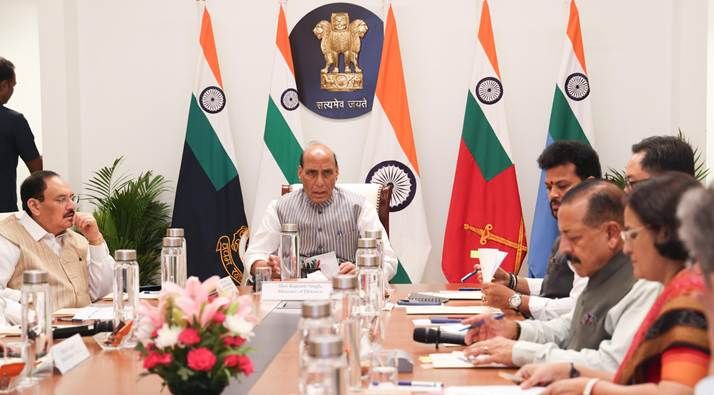
Defence Minister Rajnath Singh chaired the 5th meeting of the Informal Group of Ministers (IGoM) on West Asia at Kartavya Bhawan-2, New Delhi on May 11, 2026. The meeting took stock of the latest developments in the conflict, and discussed ways to bolster India’s readiness to ensure its minimum effect on the people. Minister of Chemicals & Fertilizers Shri Jagat Prakash Nadda; Minister of Petroleum and Natural Gas Shri Hardeep Singh Puri; Minister of Railways, Information and Broadcasting, Electronics & Information Technology Ashwini Vaishnaw; Minister of Parliamentary Affairs Kiren Rijiju; Minister of Civil Aviation Kinjarapu Rammohan Naidu, Minister of Ports, Shipping and Waterways Sarbananda Sonowal; and Minister of State (Independent Charge) of the Ministry of Science & Technology Dr Jitendra Singh attended the meeting.
The IGoM was informed that the country is secure, and there is no shortage of any petroleum product, even as most other nations have taken emergency measures to dramatically reduce domestic consumption. India has 60 days of crude oil, 60 days of Natural Gas and 45 days of LPG rolling stock. The foreign exchange reserves stand at a comfortable $703 billion. India is the world’s third largest oil refiner and fourth largest exporter of petroleum products, exporting to over 150 countries and is meeting domestic demand in full. But there is a huge cost being borne by the nation as international crude prices are continuing at very high levels. Fuel conservation can ease this burden. Prime Minister Shri Narendra Modi’s appeal to the people for collective participation to help the country deal with global economic disruptions, supply chain challenges and rising prices caused by international conflicts has, thus, emphasised prudence in usage of petroleum products and reducing wasteful consumption, so that the fiscal burden on the nation is reduced in the present and into the future.
India is among the few countries where petroleum prices have held steady through this period of global volatility even after more than 70 days since the conflict started. In many nations, prices have increased by 30 to 70 per cent. However, India’s oil marketing companies have absorbed losses of close to Rs 1,000 crore a day, with under-recoveries running to nearly Rs 2 lakh crore in Q1 ’26 so that the burden of global astronomical prices is not passed to the Indian citizens. There is no reason for anxiety, and no reason for any citizens to rush to retail outlets.
The Ministers were informed that there is a surplus amount of essential commodities for the people and the present conservation is intended towards long-run capacity building if the crisis prolongs. The supply management has been good, and the people need not panic or resort to over purchase of fuel & other products.

