


Why Saudi will lose to Houthis?
By Rohit Srivastava
The great Arab political philosopher Ibn Khaldun, in one of the greatest works on politics, the Muqaddimah, argued that desert peoples are hardy and violent, remaining much closer to nature, whereas urban populations are sedentary and live comfortable lives. In a difficult geography, desert people depend on one another for survival; Ibn Khaldun called this mutual dependence asabiyya, or group solidarity. Accustomed to freedom and resistant to ruling dynasties, these qualities help them form effective militias.
Urban populations, by contrast, live in relative comfort and tend to rely on a ruling class and military for protection. After a thorough analysis of the rise and fall of empires throughout history, Ibn Khaldun concluded that desert nomads conquer cities and establish empires through their hardiness and martial character. Yet once settled, they adopt a life of luxury, lose their asabiyya and violent edge, and eventually become vulnerable to another wave of conquerors from the desert.
This pattern can be observed not only in history but also in industry and business. Indeed, one may see its truth across the history of virtually every country in the world.
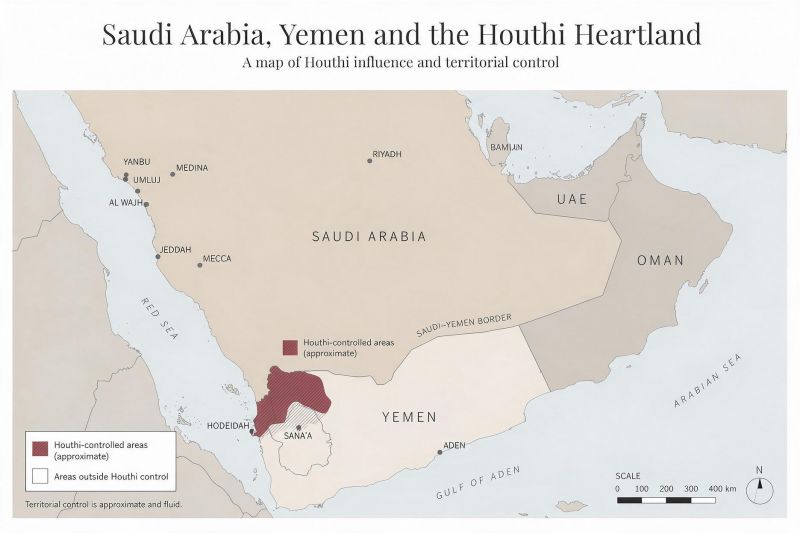
Is this not the pattern we are witnessing in West Asia today? The ongoing conflict between Saudi Arabia and the Houthis of Yemen reflects a similar dynamic. So, too, did the conflict between the more urbanised Alawites of Syria and Sunni tribal groups. Its final outcome was the collapse of President Bashar al-Assad’s Alawite-dominated regime in December 2024.
In modern attrition warfare, any aggressor is likely to lose. The reason is simple: the weapons and forces that once enabled the rapid movement of infantry in manoeuvre warfare—superior forces using armour, long-range artillery and air power to implement a shock-and-awe strategy and rapidly encircle an adversary’s command-and-control centres—are no longer sufficient to secure a quick victory.
Whoever controls a defensive position and has sufficient supplies of men, equipment and ammunition can hold out for a long time. In the modern battle of attrition, however, an organised force can still lose—as Syria recently demonstrated.
Consider Ukraine. The war continues because, although the cost of damage is heavy, the cost of sustaining hostilities has fallen. As long as Ukraine can launch drones and missiles against Russia, the war will continue. Its grinding pace is sustained by Western financial and industrial support, by Ukraine’s geography and demography, which favour a defensive posture, and by Russia’s restrained conduct of the war. With its defence ecosystem now enmeshed in Europe’s industrial and technological ecosystem, Ukraine has become the spearhead of Europe against Russia.
The lessons of Ukraine and Syria raise an uncomfortable question for Riyadh: how can Saudi Arabia withstand a force practised in attrition warfare for more than a decade, when American security guarantees appear increasingly conditional and the Kingdom must depend on its own limited defence-industrial capacity?
Saudi Arabia’s economy rests overwhelmingly on oil and gas, industries dependent on concentrated and highly exposed infrastructure. This makes the Kingdom a target-rich environment—precisely the kind of battlespace in which Houthi drone and missile warfare can impose disproportionate costs.
Although Saudi Arabia is seeking an answer through the Mecca Pact with Pakistan and Türkiye, both countries bring their own military constraints. Pakistan’s army is heavily committed in its western provinces of Khyber Pakhtunkhwa and Balochistan. It is engaged in an intermittent conflict with Afghanistan and recently suffered a defeat against India, during which several of its air bases were severely damaged. Committing a large force to defend Saudi Arabia in a distant, rugged and arid desert environment could therefore yield diminishing returns and further expose Pakistani personnel in a war of attrition.
Türkiye’s army may lack recent large-scale combat experience, but it is technologically advanced and a pioneer of drone warfare. Yet, given its strained strategic relationship with Iran—and Iran’s support for the Houthis—Türkiye has limited room for manoeuvre. It is unlikely to commit ground troops. As a result, an inexperienced Saudi army would have to confront the Houthis, who have not backed down even against the US Navy and have inflicted enough damage to deter the deployment of a major maritime force against them. If the United States withdraws its remaining forces from Iraq rather than deploying them against Iran, there may be a reason for that.
Saudi Arabia should recognise the reality: it will lose the war if it continues on its present course. Accepting the Houthis as a political reality, as the United States eventually did with the Taliban, would be the sensible course. Otherwise, after heavy casualties, the Houthis may consolidate themselves in Yemen in much the same way as the Taliban did in Afghanistan.

