


Geopolitics of Middle East and Iran
By Rohit Srivastava
On Saturday, USA and Israel launched massive air assault on strategic targets across Iran bringing end to all kind of speculations on the Trump’s plan for Iran. This war is not about Iranian regime or human rights or nuclear weapons but Iran as an independent geopolitical entity. Imam or no Imam at the helm of affair; Islam or liberalism or Zoroastrianism as guiding philosophy as long as Iran acts on national interest, it will be a challenger to the West in West Asia.
While declaring war, US President Donald Trump, in his address, highlighted the military challenge that Iran presented to US in the Middle East. “Our objective is to defend the American people by eliminating imminent threats from the Iranian regime. A vicious group of very hard, terrible people. Its menacing activities directly endanger the United States, our troops, our bases overseas, and our allies throughout the world,” president Trump said.
“For 47 years, the Iranian regime has chanted ‘Death to America’ and waged an unending campaign of bloodshed and mass murder, targeting the United States, our troops and the innocent people in many, many countries. Among the regime’s very first acts were to back a violent takeover of the U.S. Embassy in Tehran, holding dozens of American hostages for 444 days. In 1983, Iran’s proxies carried out the marine barracks bombing in Beirut that killed 241 American military personnel,” he added.
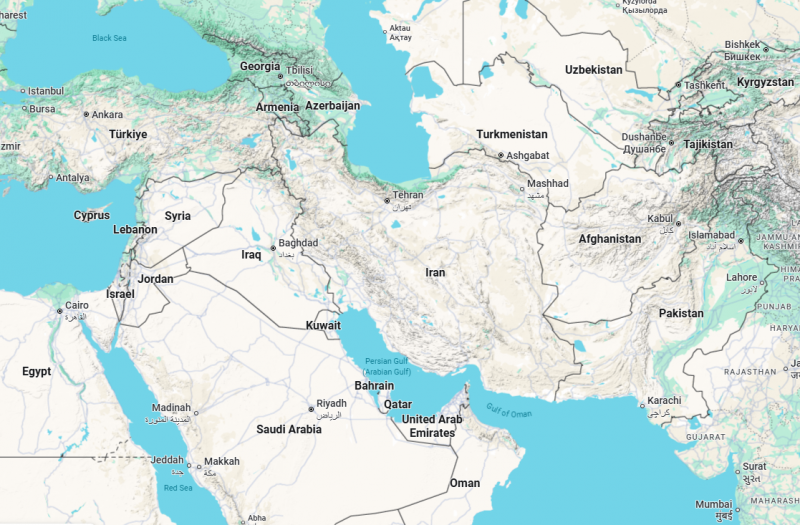
Why is Iran so vehemently anti-US? The answer lies in its geography and history. Geographically, four ends of Iran touch central Asia, Caucasia, Persian Gulf and South Asia. It is a Shia majority nation which is continuation of ancient Iranian civilization. People of Iran changed their religion, language and culture but nation remain intact. Its approach to the world didn’t change. In course of time Iran lost its territories in Caucasia. It is a civilization-nation like India and China, to some extent Russia also falls in this category representing Slavic-Orthodox Civilization-nation.
The whole argument of West, represented by US, against Iran as promoter of terrorism is based on its support to armed militia in geopolitical hotspots of Middle East. Whether Iran supports or not Houthis will resist Saudi dominance in Yemen, it has long history. So is the case with Alawite vs Sunni in Syria. When Arab countries support Sunni against Bashar regime, Iran had to support Bashar, an Alawite Shia. No one is saint.
Time has proven Iran correct. The Iranian military support to armed ethnic or religious groups in Syria, Yemen, Iraq and Lebanon is the reason why West couldn’t launch attack against Iran during the period of 2003 to 2021, when US and its NATO military were present in both Iraq and Afghanistan which together share almost half of Iran’s land boundary. The situation was perfect for launching attack but Iran used armed militia as forward defence and kept US and its allies engaged in intense conflict.
The geopolitical situation was no different throughout Iran’s history. During ancient times, Achaemenid Empire (550-330BCE) was at war with Greece and Egypt while it ruled from Turkey to Indus and Arabian Peninsula to Central Asia. It was Alexander who dismantled the empire. Thereafter, Sassanian empire was at war with Roman empire for almost 400 years, followed by Khwarazmian Empire, follower of Sunni Islam, was at war with Abbasid Caliphate (whole of Arab world) and Turcic central Asian empires, till it was annihilated by Mongols. Geopolitics didn’t change during late mediaeval era when Turkish Ottoman and Iranian Safavid fought for over a century. The war ended when two empires demarcated the borders - Caucasus was divided equally and Iraq went to Ottoman-ruled by Sunni Caliphs. Safavid rulers converted Iran Sunni to Shia Islam. Collapse of Ottoman created various nations in West Asia, but the boundaries of modern Iran is almost intact since then.
One can notice that the geopolitical perspective of Iran has remained same throughout its history. It didn’t change with changes in language, culture or religion. What we know today as Iran is a reduced version of Greater historic Iran. In last 50 years, ayatollahs have tried to dominate historic areas lost in the past – Syria, Yemen, Lebanon, Azerbaijan where different offshoots of Shia Islam thrive. Iran’s approach is no different from West’s stand on East Timor.
Since the first Gulf war (1990), through continuous military conflicts, West has disempowered the ruling elites of Middle East and Arab countries and Iran is the only military challenge to them. Besides Iran, being part of SCO and its close strategic partnership with Russia and China, gives all the more reasons for West to look at it as a military adversary. West has engaged Russia in Ukraine, taken out Venezuela and Syria; silenced Houthis, Hamas and Hezbollah through Israel’s military, hence it is free to engage Iran directly. All forward posts of Iran destroyed. And it’s happening.
What we can learn from history is whether this regime survives or replaced as long as people of Iran are nationalist and are dedicated to their identity, Iran will remain a geopolitical entity which will have valid reasons to contest external powers in its area of dominance. War or no war.

